English
 French


What Is a Busbar Machine and How Does It Work?
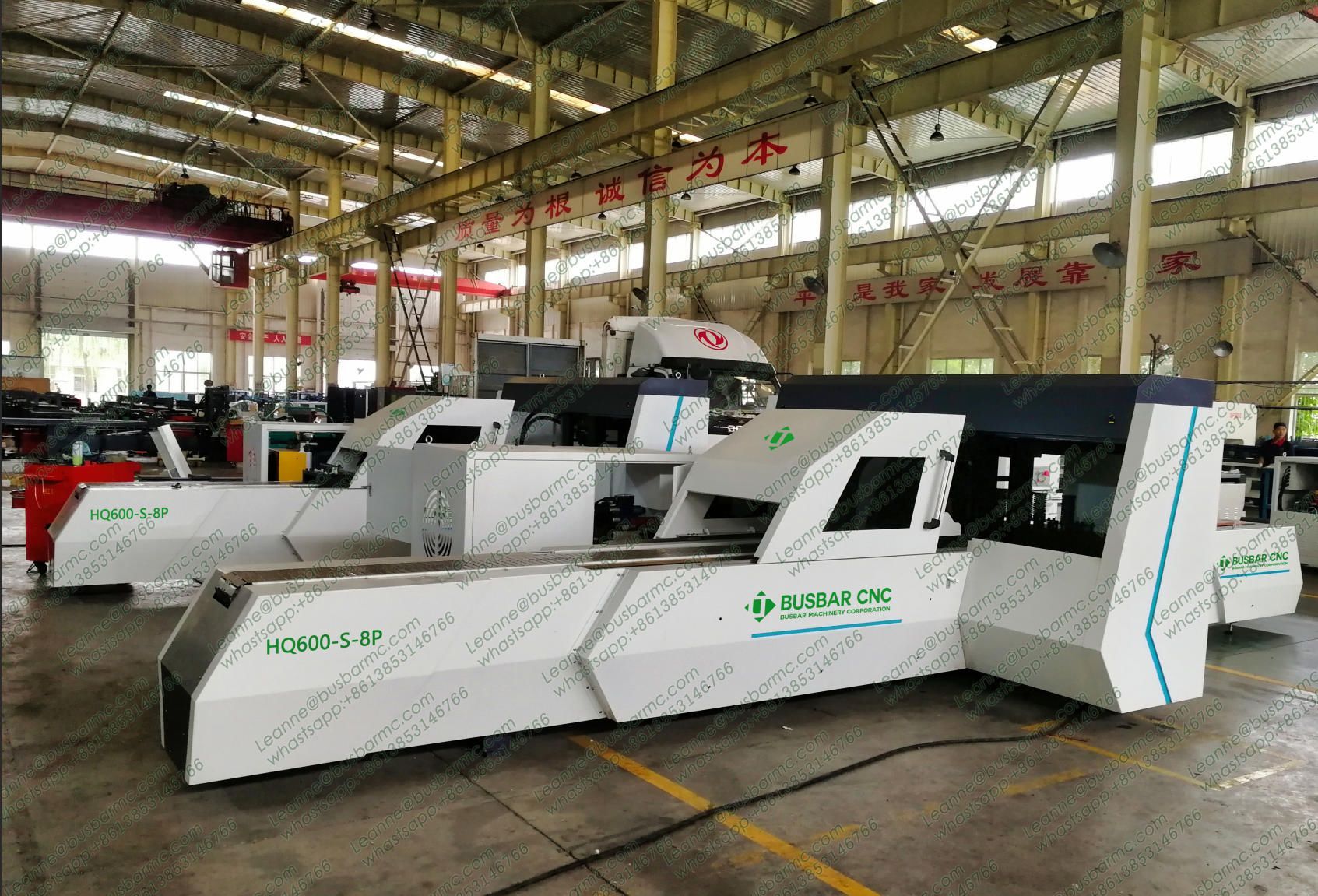
What a busbar machine actually does
Busbars replace cable harnesses inside electrical cabinets. They carry high current with a rigid, repeatable geometry, which means every part has to match the drawing in three dimensions: length, hole pattern and bend angle. Manual sawing, drilling and press-brake work can produce one good part, but it cannot repeat the same part hundreds of times without drift.
A busbar machine exists to hold those three dimensions inside tolerance at production speed. On UK panel builds this matters most where a horizontal busbar has to land on a fixed circuit-breaker pitch: a 1 mm length error at the bend line stacks up into a terminal that will not bolt down.
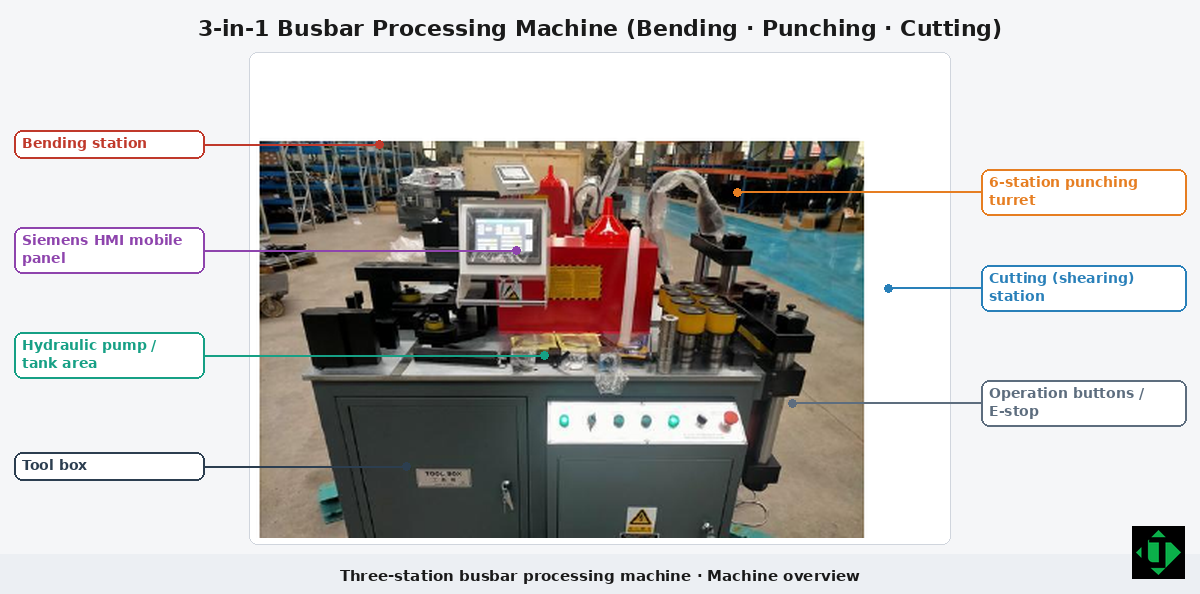
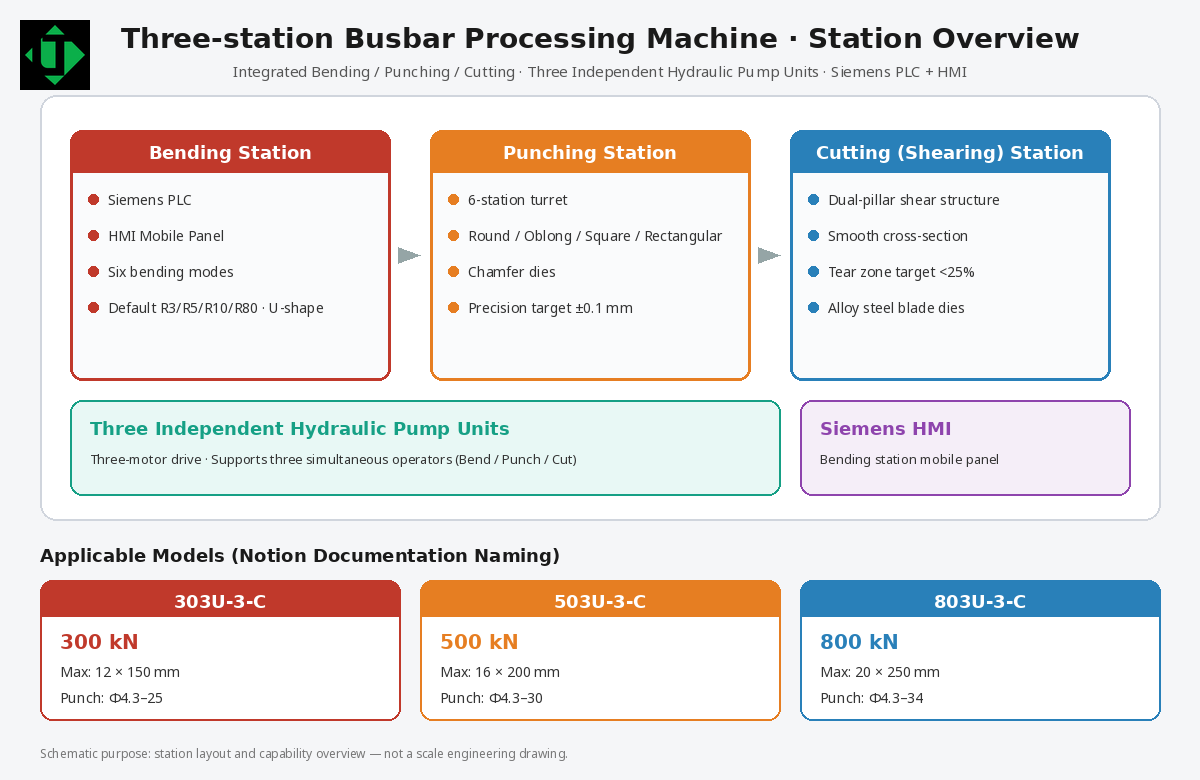
The machine therefore combines three stations. The shear station sets finished length. The punch station sets hole position and diameter. The bend station sets the angle and leg lengths.
How the three stations work
Cutting (shearing): sets the finished length with a straight, square face. The result is governed by blade clearance, hold-down pressure and hydraulic stability. Workshop acceptance is usually a tear zone under about 25% of the section, measured on the sample rather than promised on a brochure.
Punching: forms round, oblong, square or rectangular holes, and often chamfers. Die alignment, punch-to-die clearance and tonnage margin decide the result. A six-station turret keeps common dies centred so changeover is a rotation, not a rebuild.
Bending: forms flat bends, edge (vertical) bends and U, Z or L shapes. Die radius, angle control and springback compensation decide the result. Published accuracy on the LT range is about ±1° with roughly ±0.5° repeat, verified on the first article.
On many three-station machines each station has its own motor and pump group, so three operators can work simultaneously instead of queueing behind one hydraulic circuit.
Typical capacity classes
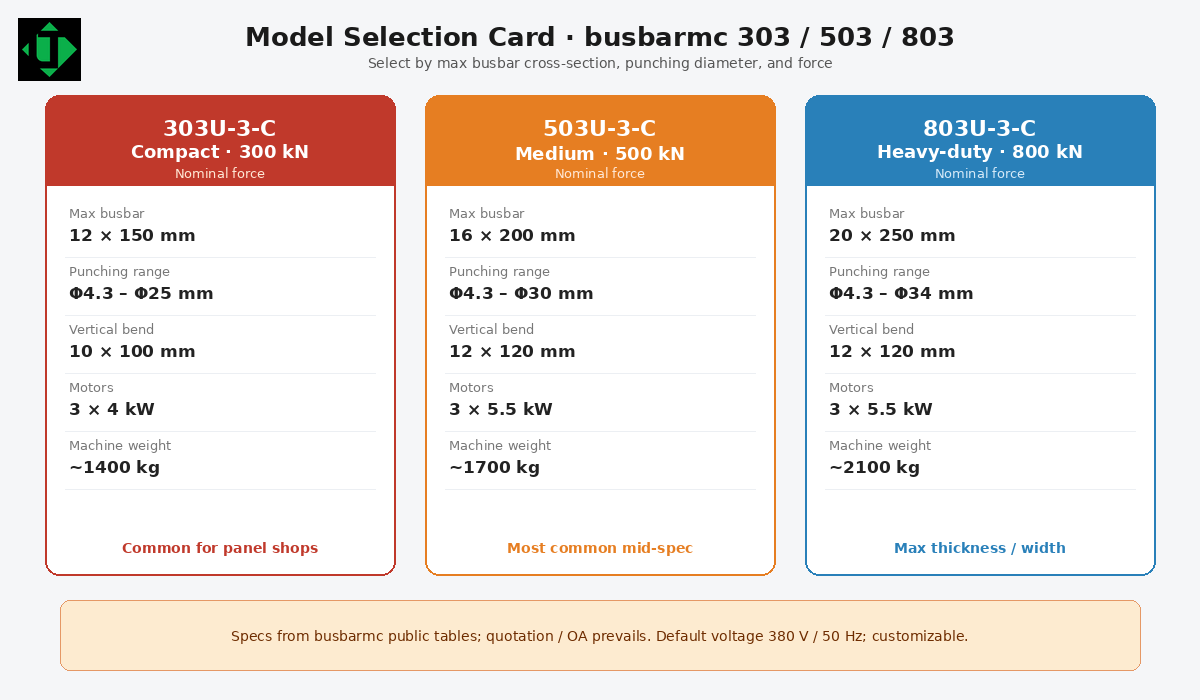
| Specification | 303U-3-C | 503U-3-C | 803U-3-C |
|---|---|---|---|
| Nominal force | 300 kN | 500 kN | 800 kN |
| Punching diameter | Φ4.3–25 mm | Φ4.3–30 mm | Φ4.3–34 mm |
| Max. thickness × width | 12 × 150 mm | 16 × 200 mm | 20 × 250 mm |
| Max. horizontal bend | 150 × 12 mm | 200 × 16 mm | 250 × 20 mm |
| Max. vertical bend | 10 × 100 mm | 12 × 120 mm | 12 × 120 mm |
| Motor power | 3 × 4 kW | 3 × 5.5 kW | 3 × 5.5 kW |
| Bend accuracy / repeat | ±1° / ±0.5° | ±1° / ±0.5° | ±1° / ±0.5° |
| Approx. mass | 1,400 kg | 1,700 kg | 2,100 kg |
Read the table backwards from your hardest part, not forwards from the average part. A shop that mostly runs 8 × 80 mm bar but occasionally needs 12 × 150 mm belongs in the 303 class, not in a smaller machine that fits the average.
Copper and aluminium are not the same job
Aluminium springs back further after the load is released, needs a larger minimum inside radius for the same thickness, and tends to smear on tooling that runs cleanly with copper. Keep separate springback tables and prove every new material with a trial bend before the first production bar. Oxide on aluminium also changes punch friction, so clearance that is correct for copper C11000 may need re-checking for 1350 or 6101 grades.
Choosing a model in five steps
List the hardest repeating part: maximum width × thickness, hole family, bend family including vertical bends.
Map that part onto the capacity table and pick the class with margin, not the class that exactly matches.
Confirm the die package: punch shapes, bend radii and any U-die.
Confirm the electrical build — UK sites normally specify 415 V / 50 Hz three-phase — and the HMI language.
Require a factory acceptance test on your own sample drawing before shipment.
Where a busbar machine fits in a UK panel shop
Typical users are switchgear assemblers, transformer manufacturers, busbar trunking fabricators, and panel builders supplying BS EN 61439 assemblies. A three-station machine suits mixed, low-to-medium volume work where one footprint has to cover cut, punch and bend. Where punching hours dominate the week, a dedicated punch-shear line plus a separate bend centre usually wins on throughput; the trade-off is floor space and handling.
For sizing help on a specific assembly, send the drawing with material grade, bar section, hole list and bend list. LT Busbar Machinery supplies UK panel builders directly from the factory and can quote against a sample drawing rather than a catalogue class.
Frequently asked questions
What is a busbar machine used for?
It shears, punches and bends flat copper or aluminium busbars used inside switchgear, distribution boards, transformers and busbar trunking. It replaces separate saw, drill and press-brake operations with one controlled process.
Can one machine cut, punch and bend copper busbars?
Yes. Three-station models such as the LT 303U-3-C, 503U-3-C and 803U-3-C integrate all three operations. Throughput still depends on loading, fixtures and whether the stations run in parallel.
What copper thickness can a busbar machine process?
It depends on the model class. The LT range covers about 12 mm on the 303, 16 mm on the 503 and 20 mm on the 803, each paired with a maximum width. Always confirm both figures together.
What is the difference between a flat bend and a vertical bend?
A flat bend forms the bar across its wide face, so capacity follows the full width. A vertical (edge) bend forms across the thickness and has a much smaller envelope, typically 10 × 100 mm on the 303 class and 12 × 120 mm on the 503 and 803.
Do I need a 3-in-1 machine or separate stations?
Choose 3-in-1 for compact workshops with mixed jobs. Move to dedicated punch and shear stations or a CNC line when volume, nesting or dedicated accuracy justify the extra floor space.