English
 French


Copper vs Aluminium Busbar Processing — Machine & Tooling Guide
Why the material choice changes the machine setup
| Factor | Copper (C11000 / Cu-ETP) | Aluminium (1350 / 6101) |
|---|---|---|
| Conductivity and mass | About 100% IACS; denser bar for the same section | About 61% IACS; roughly one third the mass, so more section for the same current |
| Punching load | Baseline for die tonnage | Softer grades mark more easily; hard alloys still need a force margin |
| Shear edge | Watch burr and blade wear | Watch clamp marks and local deformation |
| Bend springback | Baseline springback table | Typically larger compensation and a larger minimum inside radius |
| Surface | Scratches matter on contact faces | Oxide layer forms fast; protect with film and soft pads |
The practical point for a UK panel shop is that converting a job from copper to aluminium is a process change, not a material substitution. Tonnage margin, die clearance, blade life and surface protection all move at once.
Punching: clearance and hole quality
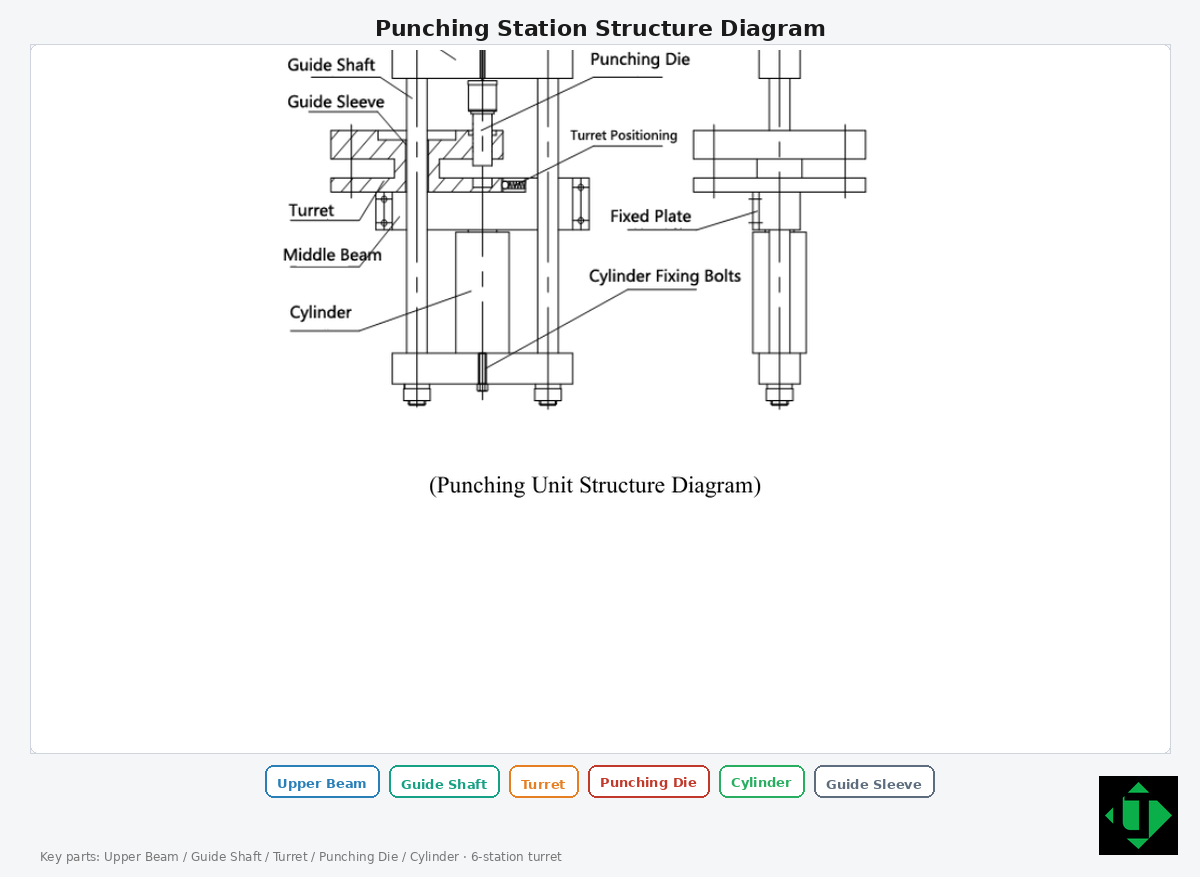
Punch quality equals die alignment plus clearance plus stripper condition plus enough force for the thickness and hole diameter. On a shared turret, keep separate clearance notes for copper and aluminium. After a material switch, inspect the first holes for burr, tear and ovality before releasing the batch.
Published punching ranges on the LT three-station range are Φ4.3–25 mm on the 303, Φ4.3–30 mm on the 503 and Φ4.3–34 mm on the 803. Those ranges are the capacity gate; clearance is what decides whether the hole is clean.
A common UK failure mode is punching dense hole fields in soft aluminium with copper clearance: the material extrudes toward the die instead of shearing, and the hole edge dishes. The fix is a tighter clearance and a slower approach, not more tonnage.
Shearing: blades and hold-down
When cutting copper, inspect burrs, end distortion and blade wear. When cutting aluminium, prioritise clamp pressure and support: excess hold-down leaves marks and can change the local shape at the cut face.
If cut quality drops after a material change, verify approved blade clearance and clamping before raising hydraulic pressure. Adding tonnage to a clearance problem makes the burr worse and shortens blade life. A workshop tear-zone target under about 25% is a reasonable FAT measurement for either material.
Bending: springback tables must stay material-specific
Flat and edge capacities differ, and the published vertical envelope is much tighter than the flat one: 10 × 100 mm on the 303 class, 12 × 120 mm on the 503 and 803.
Aluminium needs larger springback compensation. Never paste a copper HMI recipe onto aluminium without a trial bend. The reason is that aluminium has a lower modulus and a different strain-hardening curve, so the angle that recovers to 90° in copper will land several degrees open in aluminium for the same programmed over-bend.
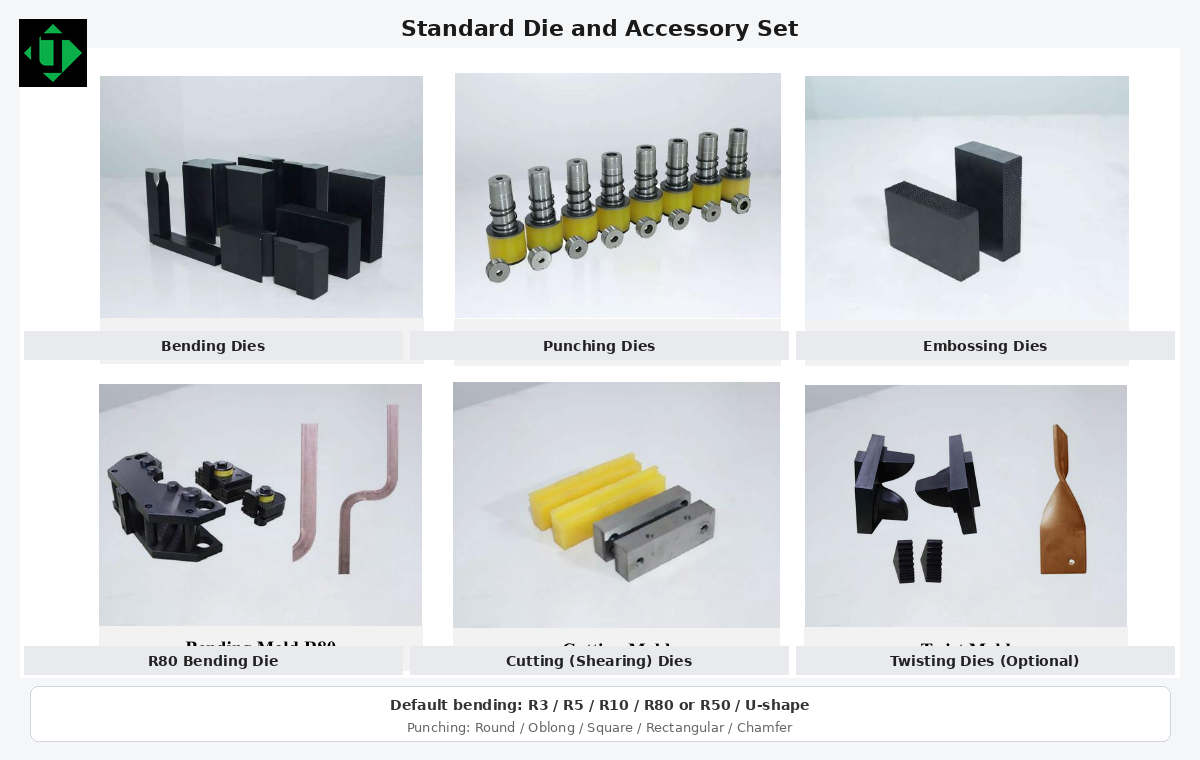
Default radius families usually include R3, R5, R10 and R80 or R50, plus U-dies. Confirm the package on the order, because radius availability limits which drawings the machine can actually run.
One machine, two materials: five practical rules
Size the machine by the hardest copper and aluminium job, not the average bar.
Store copper recipes and aluminium recipes separately in the HMI or PLC.
Change die clearance notes whenever the drawing material changes.
Run a first-article kit covering length, holes, released angle and surface.
Document FAT samples for both materials if the buyer is paying for dual capability.
Model capacity for dual-material work
| Specification | 303U-3-C | 503U-3-C | 803U-3-C |
|---|---|---|---|
| Nominal force | 300 kN | 500 kN | 800 kN |
| Punching diameter | Φ4.3–25 mm | Φ4.3–30 mm | Φ4.3–34 mm |
| Max. thickness × width | 12 × 150 mm | 16 × 200 mm | 20 × 250 mm |
| Max. horizontal bend | 150 × 12 mm | 200 × 16 mm | 250 × 20 mm |
| Max. vertical bend | 10 × 100 mm | 12 × 120 mm | 12 × 120 mm |
| Motor power | 3 × 4 kW | 3 × 5.5 kW | 3 × 5.5 kW |
| Bend accuracy / repeat | ±1° / ±0.5° | ±1° / ±0.5° | ±1° / ±0.5° |
| Approx. mass | 1,400 kg | 1,700 kg | 2,100 kg |
Buyers specifying dual capability should state both grades and tempers in the RFQ. O, H14 and T6 aluminium behave differently in the same die, and a machine that is correctly sized for copper may sit at its tonnage limit on a hard aluminium alloy of the same section.
Frequently asked questions
Can one busbar machine process both copper and aluminium?
Yes, when capacity, tooling and settings are approved for each material. Dual capability is not automatic after a copper FAT alone: the aluminium clearance, springback table and clamp pressure have to be proven separately.
Do I need different dies for aluminium?
Often yes for clearance and radius choice. At minimum, keep separate process cards even where the physical die family looks similar.
Why does aluminium bend differently from copper?
Aluminium has a lower elastic modulus and different strain hardening, so it recovers more after the load is released and needs a larger minimum inside radius. Measure the released angle, not the programmed value.
Which LT model suits mixed copper and aluminium work?
Map the largest section and the hardest hole and bend family to the 303, 503 or 803 table, then confirm the alloy and temper on the quotation.
Does aluminium need a different shear blade?
Not necessarily a different blade, but blade clearance and clamp pressure usually need re-checking. Soft aluminium marks easily under high hold-down force.