English
 French


3-in-1 Busbar Processing Machine — Punch, Cut & Bend
What a 3-in-1 is, and what it is not
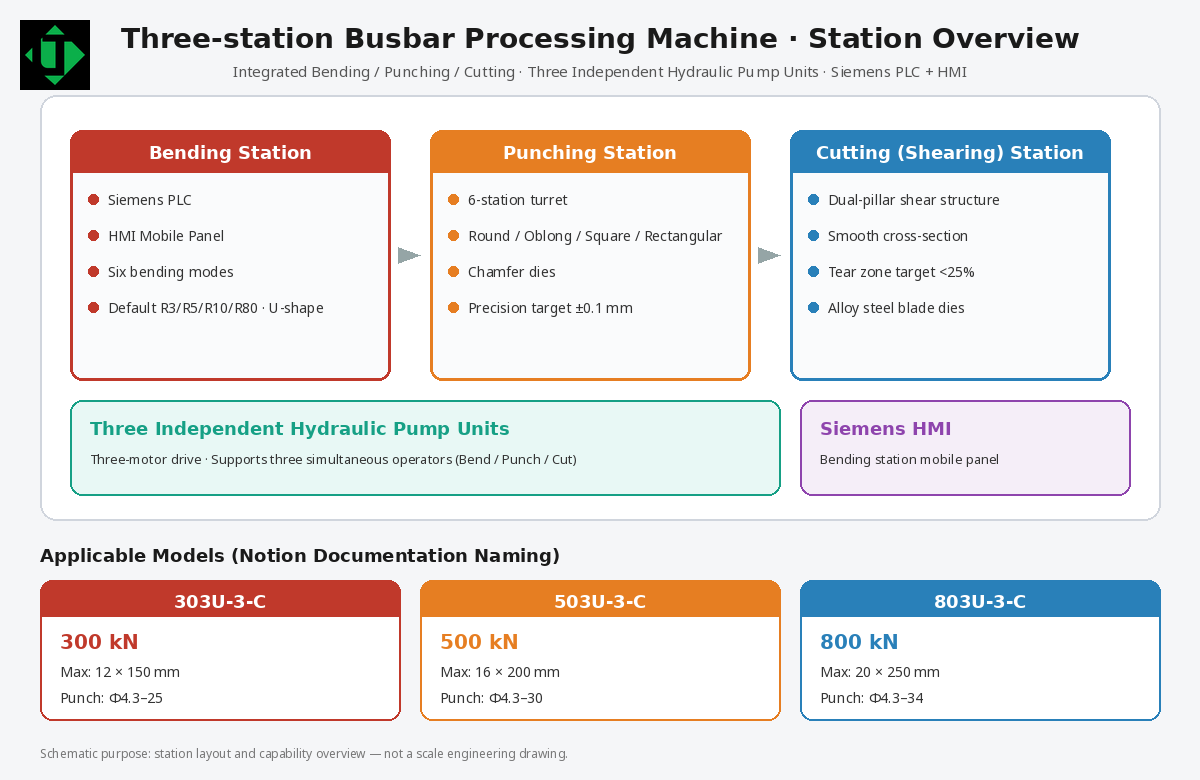
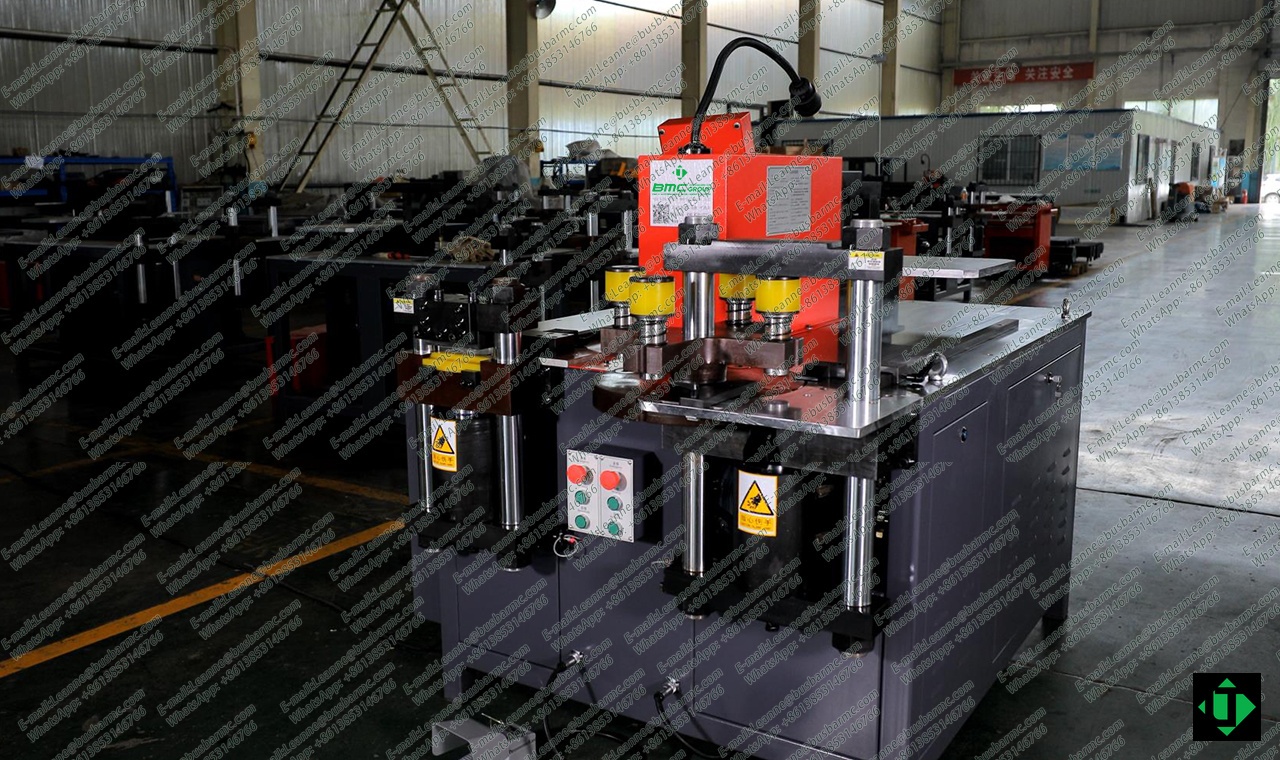
It is: one footprint for cutting, punching and bending; shared or independent hydraulics; lower layout complexity for a small or medium workshop.
It is not: a promise that every process finishes in one loading without repositioning. Operators may rotate, support and re-clamp the bar for each hole map and bend sequence. Anyone who sells it as a single-pass machine has not watched one run.
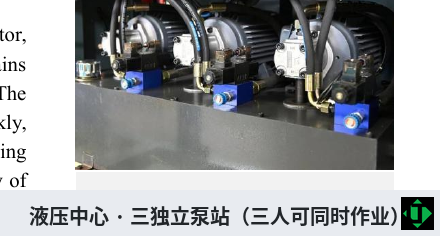
Many three-station designs use three motor-pump groups so stations can work simultaneously when three operators are assigned, or sequentially with one operator. That flexibility is the real productivity argument, not raw tonnage.
Station snapshot
| Station | Role | Buyer check |
|---|---|---|
| Punch (often a 6-die turret) | Holes and slots | Diameter range, edge distance, die list |
| Shear | Finished length | Burr, squareness, tear zone |
| Bend | Flat and edge geometry | Radius, springback, vertical limit |
Model selection card
| Specification | 303U-3-C | 503U-3-C | 803U-3-C |
|---|---|---|---|
| Nominal force | 300 kN | 500 kN | 800 kN |
| Punching diameter | Φ4.3–25 mm | Φ4.3–30 mm | Φ4.3–34 mm |
| Max. thickness × width | 12 × 150 mm | 16 × 200 mm | 20 × 250 mm |
| Max. horizontal bend | 150 × 12 mm | 200 × 16 mm | 250 × 20 mm |
| Max. vertical bend | 10 × 100 mm | 12 × 120 mm | 12 × 120 mm |
| Motor power | 3 × 4 kW | 3 × 5.5 kW | 3 × 5.5 kW |
| Bend accuracy / repeat | ±1° / ±0.5° | ±1° / ±0.5° | ±1° / ±0.5° |
| Approx. mass | 1,400 kg | 1,700 kg | 2,100 kg |
When to choose 3-in-1 versus a dedicated line
| Need | Prefer |
|---|---|
| Mixed orders, limited space | Hydraulic 3-in-1 |
| Recurring coordinates | Servo or recipe-assisted 3-in-1 |
| Punch and shear hours dominate | Dedicated punch-shear station |
| Bending is the bottleneck | Dedicated bender |
| Parallel high output | Separate stations or a line |
Quotation information checklist
| Information | Details | Confirms |
|---|---|---|
| Material | Grade, temper, maximum section, raw length | Force and handling |
| Drawing | Holes, slots, lengths, bends, radii, tolerances | Tooling and sequence |
| Production | Mix, output, changeovers, operators | Configuration and cycle |
| Acceptance | Samples, instruments, FAT | Contract scope |
UK buyers should also state the supply voltage — normally 415 V / 50 Hz — and the required HMI language, because both affect the electrical build and delivery time.
Where the three-station layout pays off
It pays off when a shop runs many short jobs rather than one long run: switchgear assemblies, transformer links, distribution board interconnects and busduct sections. Setup is short, the operator moves between stations, and one machine covers the whole route.
It stops paying when one operation dominates. If punching occupies six hours of every shift, the machine's punch station becomes the constraint and the other two sit idle. That is the point to move to dedicated capacity.
Frequently asked questions
What is a 3-in-1 busbar machine?
A single-frame machine with punching, shearing and bending stations for copper and aluminium busbars. It replaces three separate machines with one footprint.
Can three operators work at the same time?
On designs with three independent pump groups, such as the LT U-3-C range, yes, when staffing and safety allow. With one operator the stations run sequentially.
Is material feeding automatic?
Only if the quotation includes an automatic feed system. Otherwise loading and positioning remain manual or semi-manual.
How do I choose between 303, 503 and 803?
Map your hardest width and thickness plus the hardest hole and bend family onto the model table, then confirm the result on the order acknowledgement and FAT.
What is the footprint compared with three separate machines?
A 3-in-1 occupies roughly one machine footprint instead of three, which usually matters more in a UK unit where floor space is rented by the square metre.