English
 French


Busbar Fabrication Equipment Guide for Switchgear Manufacturing
Operations required for switchgear busbars
| Operation | Finished-part requirement | Equipment check |
|---|---|---|
| Cut / shear | Length, squareness, burr | Blade condition and capacity |
| Punch / slot | Size, pitch, edge distance | Die list and positioning |
| Flat bend | Released angle, radius, short leg | Springback and tooling |
| Edge (vertical) bend | Direction and tighter envelope | Separate capacity figure |
| Complex multi-bend | Assembly envelope | Sequence and interference check |
| Mark, deburr, inspect | Traceability and safe edges | Included or separate operation |
| Handling | Long and heavy bars | Rollers, crane, staffing |
The machine fabricates geometry. It does not by itself set current rating, phase spacing or clearance rules — those stay with the switchgear design and the BS EN 61439 verification.
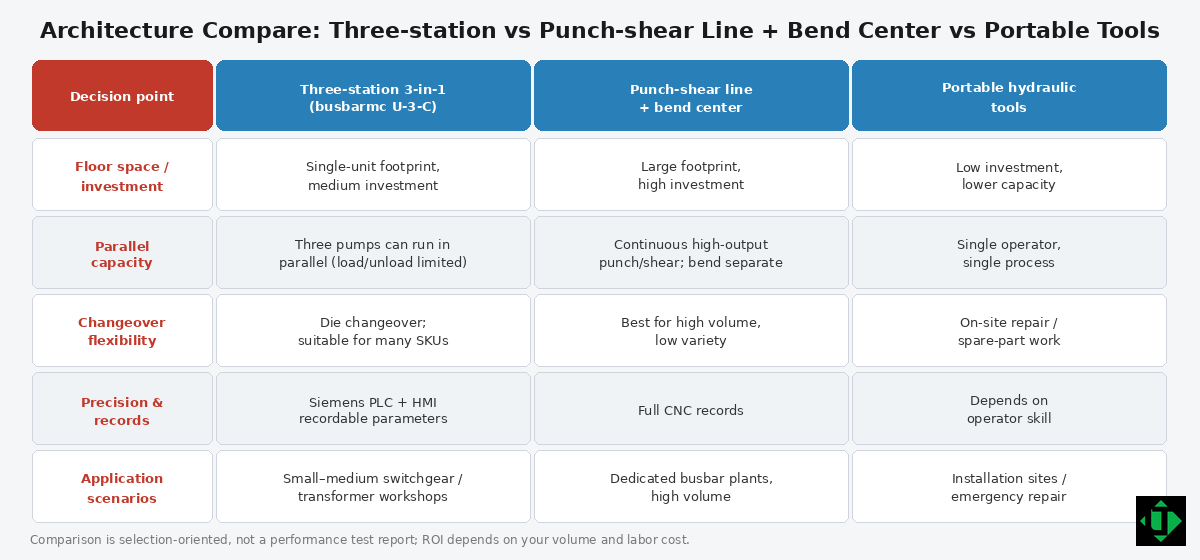
Configuration map for switchgear shops
| Production pattern | Starting configuration | Critical buyer check |
|---|---|---|
| Custom panels, lower volume | Hydraulic 3-in-1 or separate hydraulics | Per-station capacity and tooling |
| Mixed recurring models | Servo or HMI recipe 3-in-1 | Program recall and remaining manual steps |
| Repeated holes and fixed lengths | CNC punch-shear line | Feed travel, dead zone, nesting |
| Complex or bottleneck bending | Dedicated programmable bender | Short leg, springback, clearance |
| High parallel workload | Separate punch, cut and bend | Queue time and staffing |
| Wide, thick or long bars | Heavy class plus external support | Max-size test on FAT |
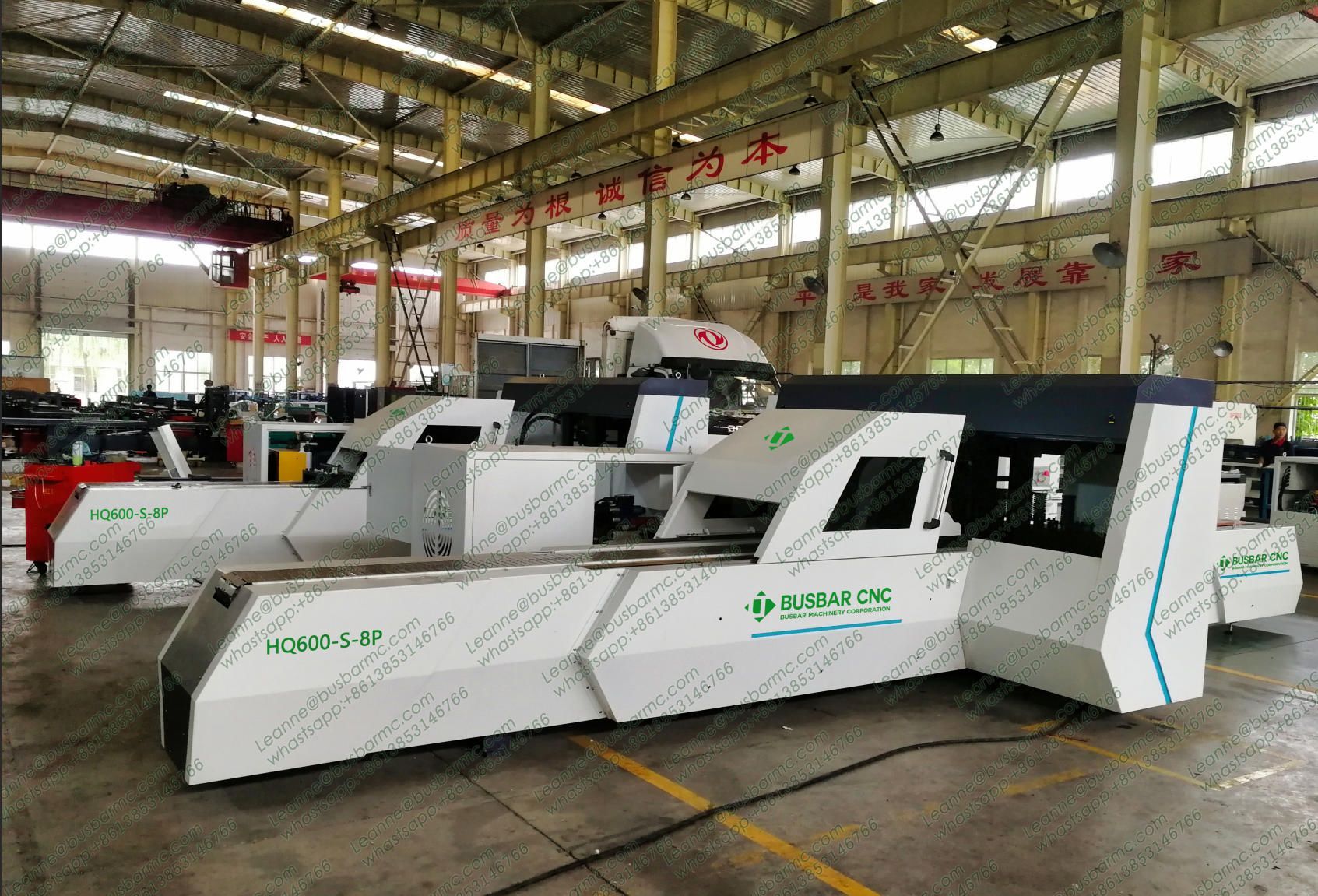
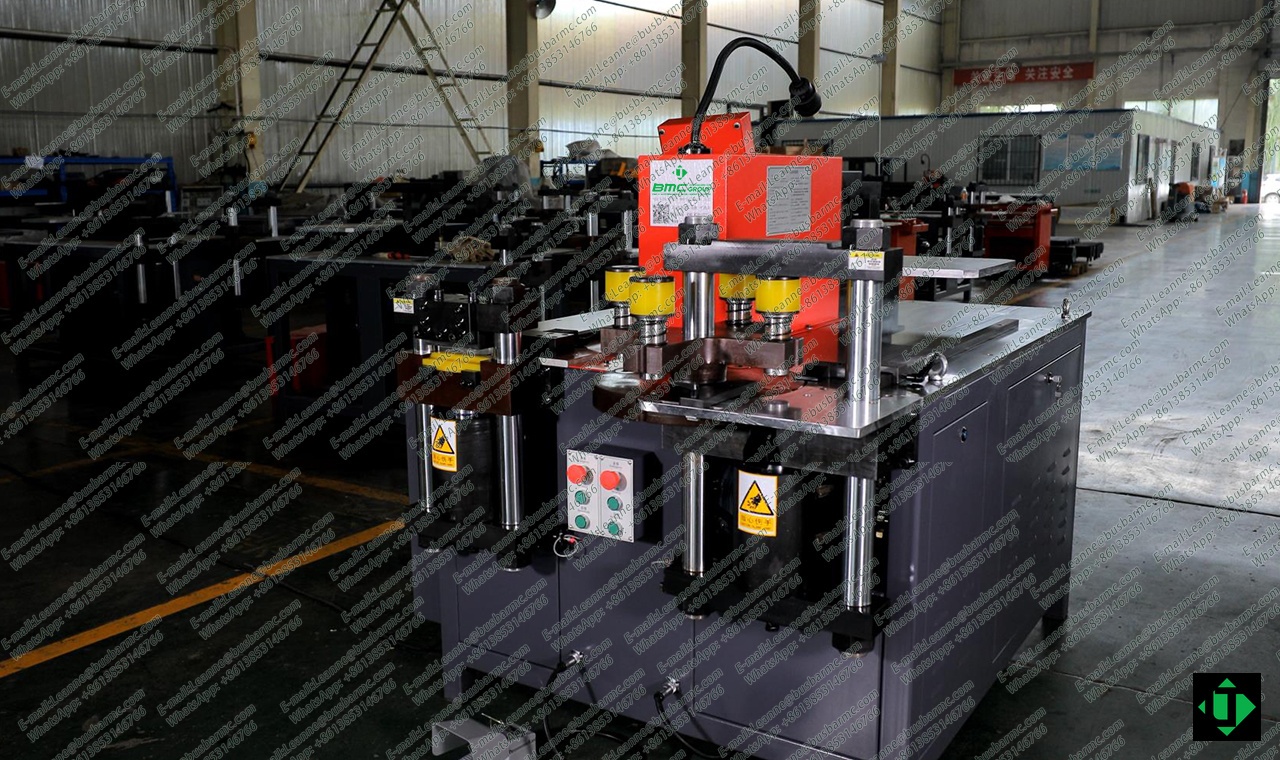
Why a 3-in-1 fits many panel builders
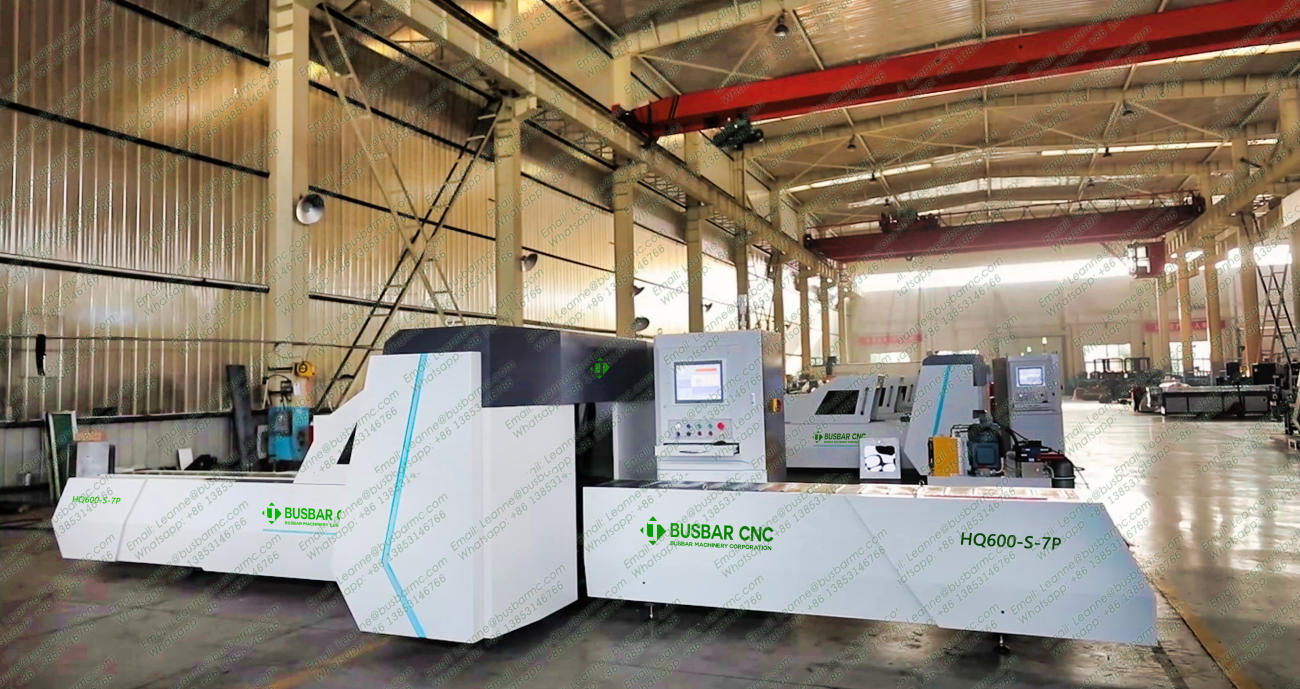
One frame hosts the punch turret, shear and bend with three pump groups, allowing sequential or parallel staffing. For a UK panel shop with two to four fabricators, that is usually the difference between one operator waiting and three operators working.
The constraint is the single-frame capacity ceiling: the machine is only as capable as its smallest station envelope. Before ordering, convert every drawing in your current product range into a maximum width, thickness, hole diameter, flat bend and vertical bend figure, then check the worst case against the table.
Model capacity
| Specification | 303U-3-C | 503U-3-C | 803U-3-C |
|---|---|---|---|
| Nominal force | 300 kN | 500 kN | 800 kN |
| Punching diameter | Φ4.3–25 mm | Φ4.3–30 mm | Φ4.3–34 mm |
| Max. thickness × width | 12 × 150 mm | 16 × 200 mm | 20 × 250 mm |
| Max. horizontal bend | 150 × 12 mm | 200 × 16 mm | 250 × 20 mm |
| Max. vertical bend | 10 × 100 mm | 12 × 120 mm | 12 × 120 mm |
| Motor power | 3 × 4 kW | 3 × 5.5 kW | 3 × 5.5 kW |
| Bend accuracy / repeat | ±1° / ±0.5° | ±1° / ±0.5° | ±1° / ±0.5° |
| Approx. mass | 1,400 kg | 1,700 kg | 2,100 kg |
Selection and FAT for switchgear RFQs
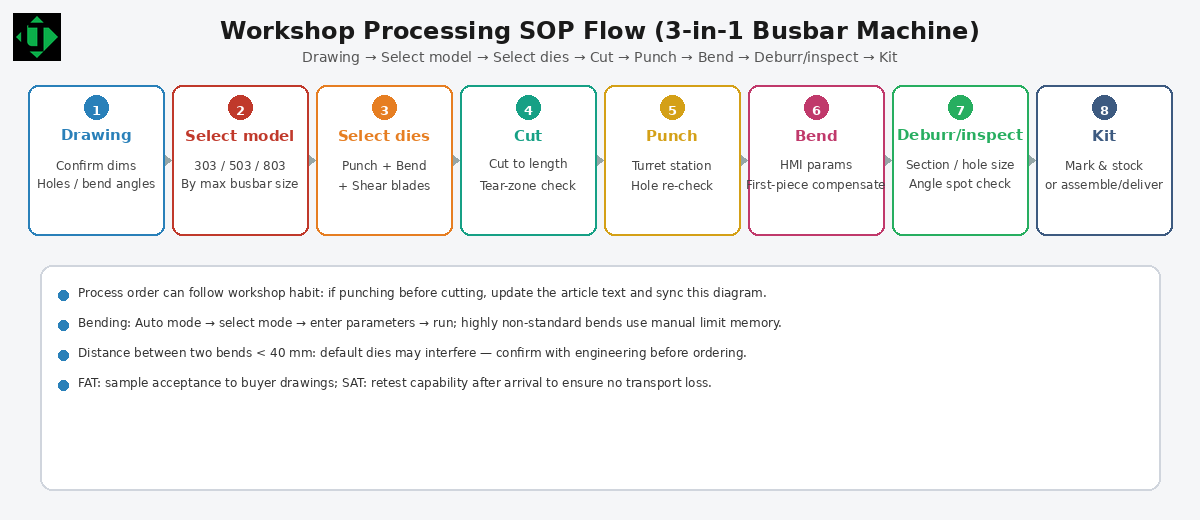
Send representative cabinet busbar drawings showing holes, bends and lengths.
State copper or aluminium, temper, maximum section and monthly mix.
List the must-hit tolerances and the inspection instruments you will use.
Agree the FAT sample set: first, middle and last of a short run.
Confirm voltage (415 V / 50 Hz for UK sites) and the HMI language.
A well-prepared RFQ with drawings usually shortens the quotation cycle and eliminates the two most common disputes later: an undersized tonnage class and a missing die.
Frequently asked questions
What equipment does switchgear busbar work need?
Typically cutting, punching, bending, deburring, marking and inspection, plus handling equipment for long bars. Small shops combine the first three in a three-station machine.
Is a 3-in-1 machine enough for switchgear manufacturing?
Often yes for mixed SME work. Scale to dedicated stations or a CNC line when volume or parallel load outgrows a single frame.
What is the difference between flat and edge bends in cabinets?
Both appear in switchgear assemblies. Edge or vertical capacity is usually much tighter, so verify it as a separate figure rather than assuming the flat-bend capacity applies.
Does the machine set electrical clearances?
No. It produces mechanical geometry to drawing. Current rating, phase spacing and clearance rules remain part of the approved switchgear design.
What should a switchgear FAT include?
Representative parts measured for length, hole positions from datum, released bend angles, surface condition and variation across consecutive parts.