English
 French


Copper Busbar Machine Selection — Punch, Cut & Bend
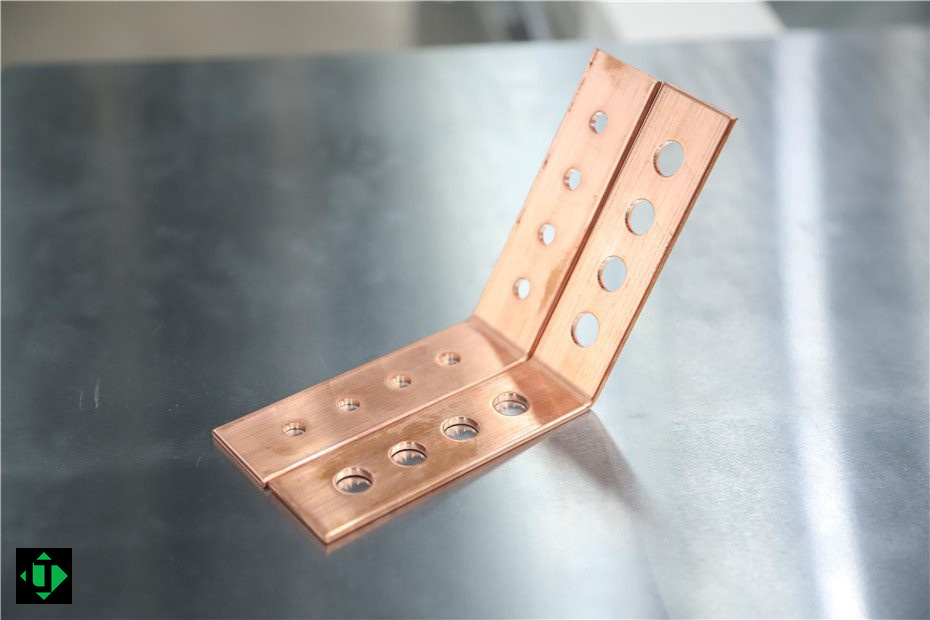
Copper applications that drive machine choice
| Application | What to review |
|---|---|
| Switchgear and distribution panels | Hole layout, bend structure, cabinet clearances |
| Transformer connections | Section, terminal holes, surface finish, interface |
| Busduct and long runs | Length support, joint design, volume |
| Energy storage and charging | Dense hole fields, compact bends, surface control |
Select from the finished-part family, not from the application name alone. Two switchgear builders can have completely different bar populations.
Process route options
| Route | Best fit | Trade-off |
|---|---|---|
| Hydraulic 3-in-1 | Mixed copper kits, limited floor space | Manual transfer between stations |
| CNC or servo-assisted 3-in-1 | Recurring copper drawings | Still a one-frame capacity ceiling |
| Dedicated punch, shear, bend | High hours per process | More footprint and handling |
| Automatic CNC line | High volume with nesting | Higher capital cost and floor space |
Tooling that actually defines copper capability
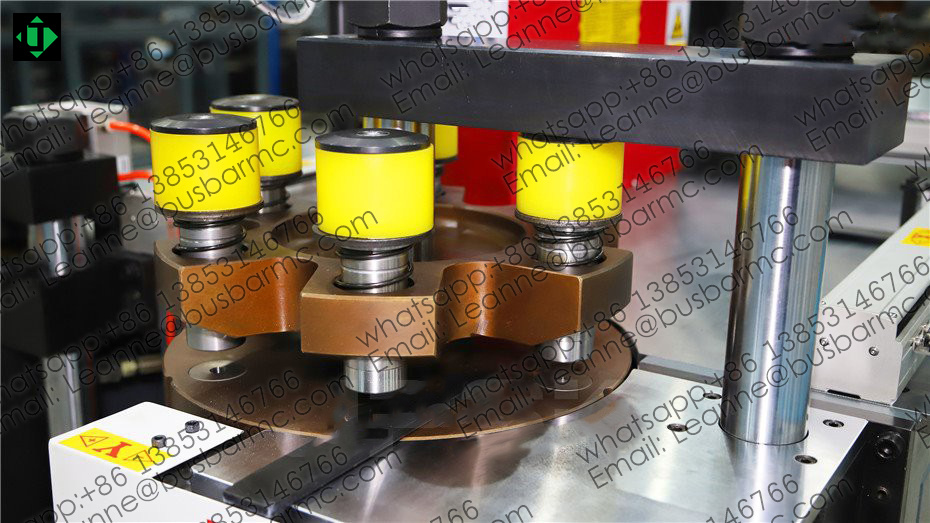
Punch: round and oblong families; published ranges Φ4.3–25, Φ4.3–30 and Φ4.3–34 mm across the 303, 503 and 803 classes.
Shear: blades and clearance matched to copper temper. Hard-drawn copper needs more force and wears blades faster than annealed.
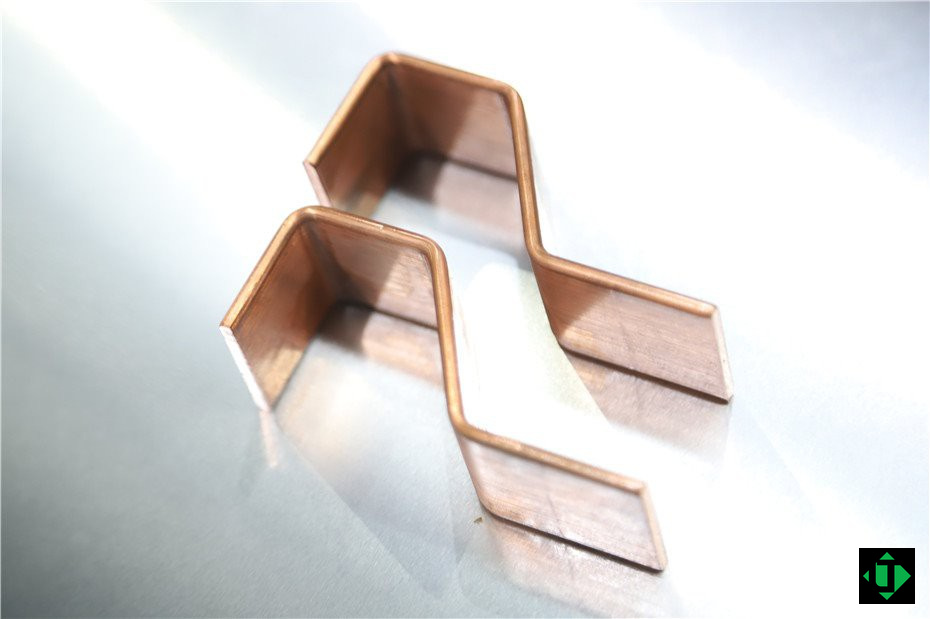
Bend: R3, R5, R10, R80 or R50 dies plus U-dies, with flat and edge modes on the Siemens HMI.
Options: embossing and twist only if ordered — they are separate die packages, not standard.
This is why two machines with identical tonnage can quote very differently: the die package decides what the machine can actually produce.
Model card — sizing the copper envelope
| Specification | 303U-3-C | 503U-3-C | 803U-3-C |
|---|---|---|---|
| Nominal force | 300 kN | 500 kN | 800 kN |
| Punching diameter | Φ4.3–25 mm | Φ4.3–30 mm | Φ4.3–34 mm |
| Max. thickness × width | 12 × 150 mm | 16 × 200 mm | 20 × 250 mm |
| Max. horizontal bend | 150 × 12 mm | 200 × 16 mm | 250 × 20 mm |
| Max. vertical bend | 10 × 100 mm | 12 × 120 mm | 12 × 120 mm |
| Motor power | 3 × 4 kW | 3 × 5.5 kW | 3 × 5.5 kW |
| Bend accuracy / repeat | ±1° / ±0.5° | ±1° / ±0.5° | ±1° / ±0.5° |
| Approx. mass | 1,400 kg | 1,700 kg | 2,100 kg |
Quick cue: the 303 covers roughly a 12 × 150 mm section with holes to Φ25; the 503 covers 16 × 200 mm with Φ30; the 803 covers 20 × 250 mm with Φ34.
How to compare output fairly
Do not compare machines by stroke rate alone. Complete cycle time includes loading, setup, tooling change, positioning, punching, transfer, shearing, bending, correction, unloading and inspection. Use the same copper drawing across suppliers and record operators, setup time, conforming parts, rejects and manual interventions.
A machine that is 15% faster in the punching stroke but needs an extra tool change per drawing will lose on a real shop floor. Measure minutes per conforming part, not strokes per minute.
RFQ package for copper machines
| Send this | Used to confirm |
|---|---|
| Grade, temper, maximum section | Force and handling |
| Drawings with holes, bends, lengths | Dies and sequence |
| Batch mix and required output | 3-in-1 versus line |
| FAT criteria and instruments | Acceptance |
| Voltage and destination | Electrical build |
Frequently asked questions
Can one machine cut, punch and bend copper?
Yes. LT three-station models integrate all three operations. Throughput still depends on staffing and on whether the pump groups run in parallel.
Is nominal force enough to select a copper machine?
No. Verify each station separately against your hardest hole, shear and bend family. Nominal force is one gate, not the whole specification.
What copper thickness can the LT range process?
About 12 mm, 16 mm and 20 mm maximum thickness on the 303, 503 and 803 classes. Always pair the thickness with the maximum width and the bend limits.
What should a copper FAT include?
Representative parts measured for length, hole positions, released bend angles, surface condition and variation between consecutive parts.
Do I need a CNC line for copper busbars?
Only if volume and nesting justify it. Most UK panel shops are better served by a correctly sized 3-in-1 with a good die package and a disciplined first-article routine.